
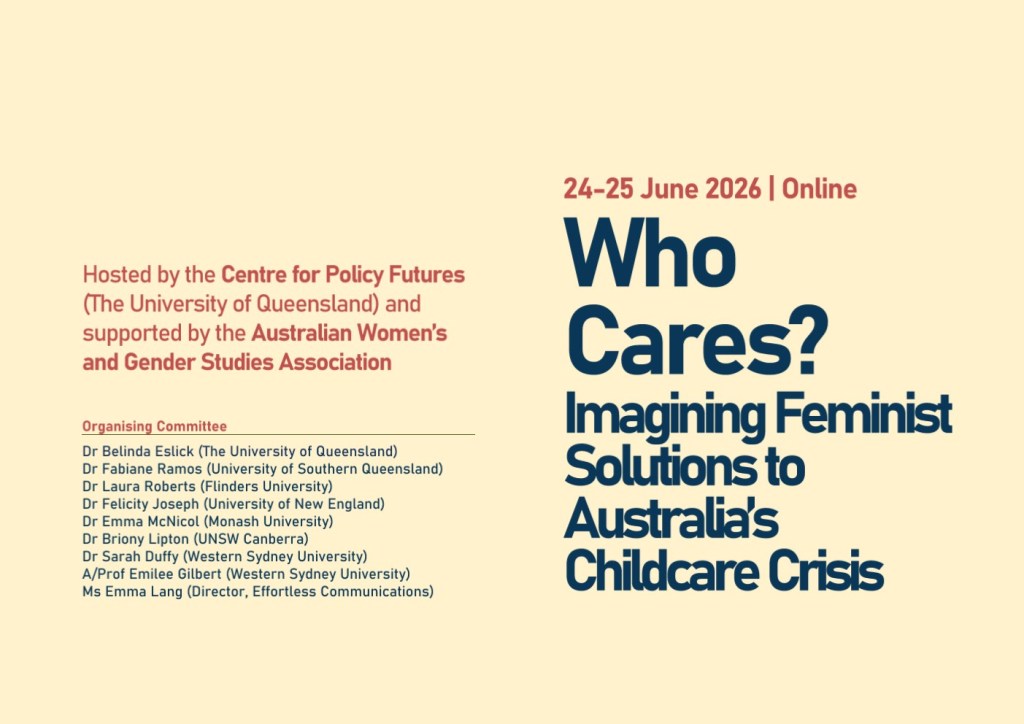
Who Cares?
Imagining Feminist Solutions to Australia’s Childcare Crisis
Research Symposium & Roundtable
Online | 24-25 June 2026 | REGISTER HERE
Hosted by the Centre for Policy Futures, The University of Queensland
Supported by the Australian Women’s and Gender Studies Association
If we could start from scratch, what would a genuinely feminist care ecosystem look like?
Australia faces a deepening care crisis. Centre-based childcare is under heightened scrutiny following investigations by ABC’s Four Corners, which uncovered systemic issues including sub-standard care, neglect, and abuse.
The broader care ecosystem is also in crisis, as unpaid reproductive labour and childcare—disproportionately undertaken by women, especially mothers—remains chronically devalued by our governments, economy, and society.
Alongside this care crisis, Australia faces numerous related challenges: declining fertility rates; deepening cost-of-living and housing crises; and the resurgence of regressive, misogynistic gender ideals (including ‘tradwife’ and ‘manosphere’ rhetoric) that idealise women’s economic dependence, subordination to men, and domestic confinement.
These issues are not isolated but stem from the systemic devaluation of reproductive labour and care—and they require urgent attention.
We are bringing together feminist scholars, advocates, and policy stakeholders to imagine a more supportive Australian care ecosystem for mothers, children, and families.
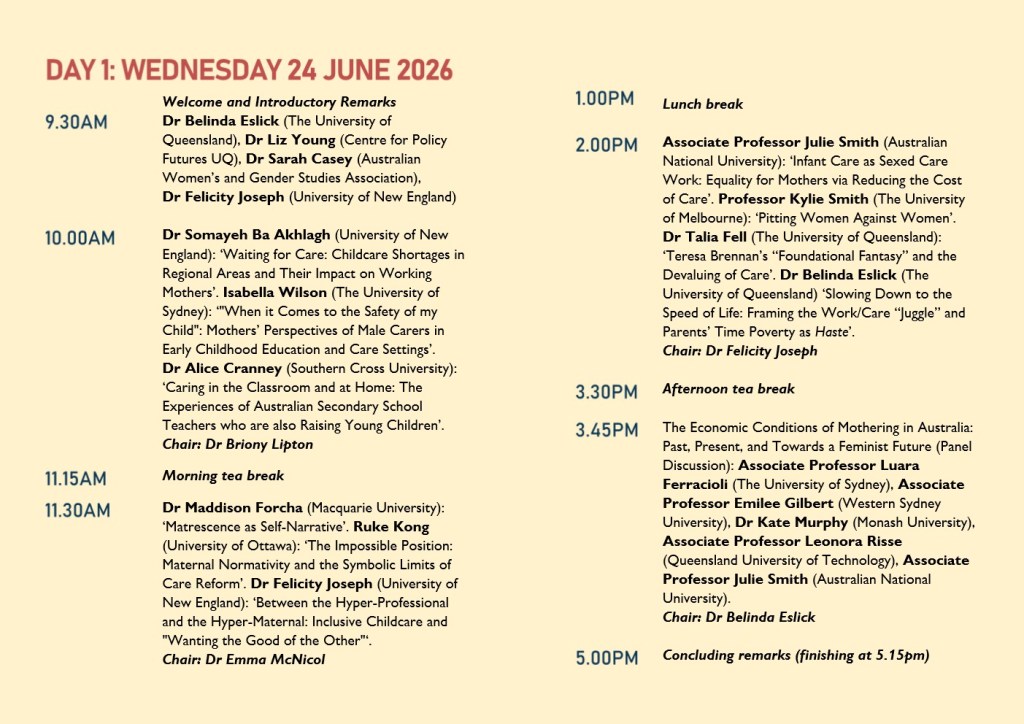
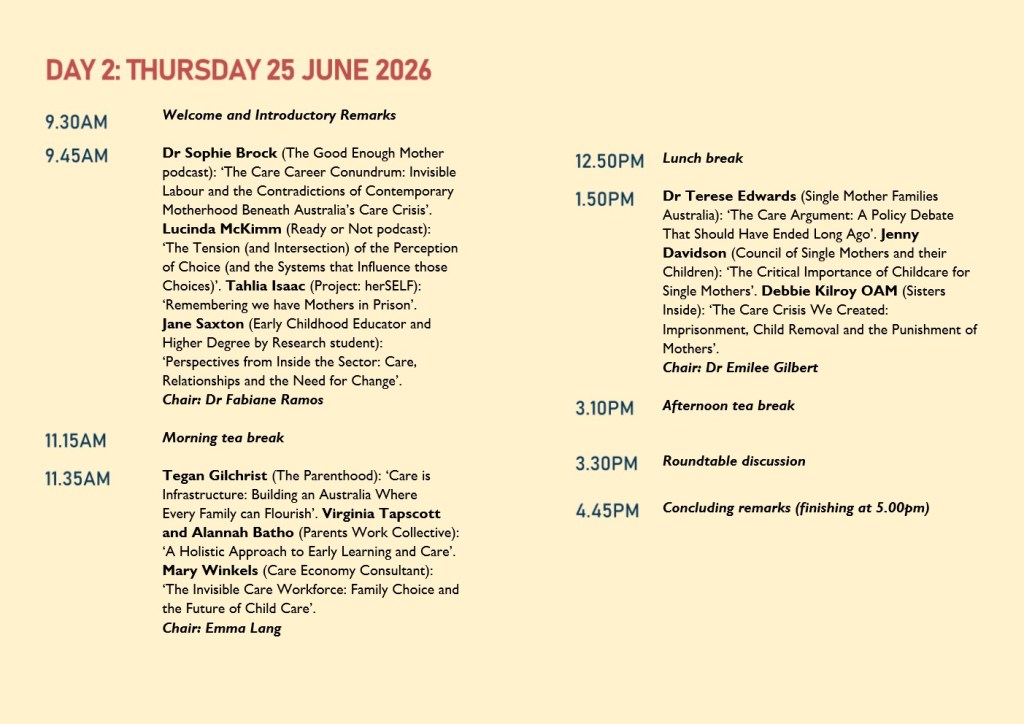
PROGRAM OUT NOW:
CALL FOR PAPERS & EXPRESSIONS OF INTEREST – NOW CLOSED
Australia faces a deepening care crisis. Centre-based childcare is under heightened scrutiny following investigations by ABC’s Four Corners, which uncovered systemic issues including sub-standard care, neglect, and abuse. The broader care ecosystem is also in crisis, as unpaid reproductive labour and childcare—disproportionately undertaken by women, especially mothers—remains chronically devalued by our governments, economy, and society.
Women’s participation in paid employment has increased substantially in recent decades. At the same time, cost-of-living and housing pressures are pushing many mothers to return to paid work sooner than they feel ready, often taking on longer hours and greater responsibilities than they deem sustainable while raising infants and children. This shift has not been matched by structural recognition of reproductive labour or a meaningful redistribution of unpaid labour and care within households, with care work continuing to be undervalued as an essential part of Australia’s social infrastructure. Paid parental leave remains inadequate and fails to properly recognise the value of caring for children, while schooling systems and workplace standards remain fundamentally incompatible. Workers in childcare centres (predominantly women) are underpaid, and consistently report feeling undervalued.
Meanwhile, multidimensional societal and economic pressures have contributed to the erosion of broader familial and informal care networks. Combined with inadequate community, government, and workplace support for mothers and families, especially in the early years, this has left many mothers and parents overburdened, profoundly impacting their wellbeing. These impacts are notably stratified by factors such as social and economic class, ethnicity, partnered status, age, and ability (Sheeran, Jones & Perolini, 2019; Wilson, Buchler & Baxter, 2025).
The financial impact of these conditions, popularly dubbed the ‘motherhood penalty’, is well-documented (Bahar, Bradshaw, Deutscher and Montaigne, 2023) but the broader impacts on mothers’ overall wellbeing and freedom are less recognised in public discourse.
Alongside this care crisis, Australia faces numerous related challenges: declining fertility rates; deepening cost-of-living and housing crises, and the resurgence of regressive, misogynistic gender ideals (including ‘tradwife’ and ‘manosphere’ rhetoric) that idealise women’s economic dependence, subordination to men, and domestic confinement. These issues are not isolated but stem from the systemic devaluation of reproductive labour and care—and they require urgent attention.
Accordingly, we are bringing together scholars, advocates, and policy stakeholders to imagine a more supportive Australian care ecosystem for mothers, children, and families. The event asks: if we could start from scratch, what would a genuinely feminist care ecosystem look like?
We invite abstracts for scholarly papers and/or panels for an online symposium and roundtable, to be held on 24-25 June 2026, exploring feminist responses to Australia’s childcare crisis. We also invite expressions of interest from advocates, advocacy organisations, and policy stakeholders to give short presentations and/or contribute to a roundtable discussion on alternatives to current childcare and family policy.
Current public debate on childcare policy is largely dominated by two positions. The Australian Labor Party and major advocacy groups are pushing for a universal, centre-based childcare model for infants and children under four—a policy framework that has been in the pipeline under multiple federal governments. On the other hand, recent calls from advocates to expand ‘childcare choice’ (a voucher-style approach to the Childcare Subsidy) have gained support from Liberal leader Angus Taylor. However, current debates on childcare are ideologically and conceptually muddled and require closer and more nuanced scrutiny.
Meanwhile, the voices of mothers, especially those across varying social strata, are largely absent from debates, and we have noted a concerning absence of meaningful feminist perspectives examining how childcare and family policy reforms could best meet their needs and desires.
We also note a concerning absence of public discussion of the widely varying experiences of motherhood and parenthood across different socio-economic contexts and the significance of factors including class, race and ethnicity, migrant status, partnered status, age, and ability in policy design and advocacy. For example, while policies such as universal childcare are framed as a gender equality measure by facilitating maternal workforce participation, the current conditions of both motherhood and the workplace are far from emancipatory for many mothers.
bell hooks (1984/2015) notes that, in the mid- to late-twentieth century, some feminist perspectives marginalised many working-class women and/or women of colour who found mothering an affirming interpersonal relationship as well as an escape from the world of alienating work in the labour market. Similarly, Silvia Federici (2020, pp. 27-28) describes how the struggle for welfare (largely led by Black mothers) was sidelined by parts of the women’s liberation movement in the U.S., warning that:
The inability of the feminist movement to fight to guarantee that no woman should be denied the right to have children because of the material conditions of her life…have created divisions between white and black women that we must not reproduce. (pp. 27-28)
We hold concern that current debates risk repeating mistakes of earlier feminist movements by failing to meaningfully engage mothers, sidelining the welfare struggle, overlooking the needs of marginalised mothers, and devaluing reproductive labour and care that occurs outside the market economy.
In her landmark feminist study on mothering, Of Woman Born: Motherhood as Experience and Institution, Adrienne Rich claims:
Mass childcare in patriarchy has had but two purposes: to introduce large numbers of women into the labour force, in a developing economy or during war, and to indoctrinate future citizens. It has never been conceived as a means of releasing the energies of women into the mainstream culture, or of changing the stereotypic gender-images of both women and men. (Rich, 1976/2021: pp. xii-xiii)
Following Rich’s critique, we ask how childcare—and the broader care ecosystem—could be redesigned to best support mothers’ and families’ overall wellbeing and flourishing rather than primarily as a mechanism to increase economic productivity. This event represents an opportunity to imagine a better model.
We acknowledge that not all birthing parents identify as mothers and that there is a diversity of parenting and family configurations that go beyond binary gendered identities and/or that do not have mothers (e.g., single fathers). This event is driven by an inclusive feminist ethos. While there is an emphasis on the experiences of mothers within the childcare crisis, we acknowledge diversity of family configurations and experiences.
We invite abstracts from all academic disciplines. We want to:
- ensure that any reform is informed by the needs and desires of mothers and families rather than short-term economic gain (wellbeing-driven rather than GDP-driven).
- ensure any reform will not further entrench disadvantage (e.g., the inequity of the current model whereby those with wealth can afford more time with their family and can buffer the stressors of raising children; the potential pitfalls of a voucher system in driving inequity).
- recognise maternity and the value and effort of maternal labour and care without entrenching regressive ideals about women’s social roles.
- meaningfully address the motherhood penalty in ways that don’t require full-time paid workforce participation in combination with primary caregiving.
- improve the conditions of parenthood to ensure mothers and families can live meaningful and fulfilling lives, including adequate time and resources for rest, leisure, reproductive labour, care, time with family, and civic participation.
Potential areas of consideration include but are not limited to:
- The differing impacts of current and proposed policy on different social strata including race, class, age, partnered status (partnered or sole/single parent), additional needs of children and/or parents, location (i.e., rural, regional, and proximity to support, workplaces, and communities).
- The kinds of social infrastructure, subsidies/government payments, and services that could best support mothers and families to flourish and reduce the physical, mental, and emotional load.
- LGBTIQ+ perspectives on the childcare crisis.
- What we can we learn from other models around the world.
- What needs to change to make motherhood and parenthood a less isolating role. (How can we expand our ‘circles of care’ to include more carers?)
- How to balance mothers’ ability to step back from paid work or career progression while still maintaining and developing identities beyond motherhood.
- How our built environments can be designed to best support caregiving.
This event is gratefully supported by the Australian Women’s and Gender Studies Association (AWGSA). We hope it will garner new connections and collaborations among emerging and established scholars across various disciplines while fostering meaningful collaboration between feminist scholars and policy stakeholders.
We will present the outcomes of the symposium in a white paper and aim to collate research presented at the symposium in an edited volume for an academic press.
This is an inclusive event, and all are welcome.
EVENT DETAILS
24-25 June 2026 | Online | Free registration
REGISTER HERE.
The event will be held in two parts.
Day One will be a series of scholarly papers and panels.
Day Two will see presentations from advocates and policy stakeholders followed by a roundtable discussion where all will be invited to imagine a better, genuinely feminist care ecosystem and begin to discuss concrete policy alternatives.
Please submit a 200-word abstract (papers), 500-word abstract (panels), or 200-word expression of interest (advocate and policy stakeholder presentations) and a short bio for each presenter by 17:00 Friday 22 May 2026 to: feministchildcaresymposium@gmail.com
ORGANISING COMMITTEE
Dr Belinda Eslick (The University of Queensland), Dr Fabiane Ramos (University of Southern Queensland), Dr Laura Roberts (Flinders University), Dr Felicity Joseph (University of New England), Dr Emma McNicol (Monash University), Dr Sarah Duffy (Western Sydney University), Associate Professor Emilee Gilbert (Western Sydney University), Dr Briony Lipton (UNSW Canberra), Ms Emma Lang.
References:
Bahar, E., Bradshaw, N., Deutscher, N., & Montaigne, M. (2025). Children and the Gender Earnings Gap: Evidence for Australia. The Economic Record, 101(332), 41–75. https://doi.org/10.1111/1475-4932.12834
Federici, S. (2020). Beyond the periphery of the skin : rethinking, remaking, and reclaiming the body in contemporary capitalism (1st ed.). PM Press.
hooks, bell. (2015). Revolutionary Parenting. In Feminist Theory (3rd ed., pp. 133–147). Routledge. https://doi.org/10.4324/9781315743172-10
Rich, Adrienne. (1976/2021). Of woman born : motherhood as experience and institution (1st ed.). W. W. Norton & Company, Incorporated.
Sheeran, N., Jones, L., & Perolini, J. (2019). Intersecting identities: How race and age influence perceptions of mothers. Australian Journal of Psychology, 71(3), 261–272. https://doi.org/10.1111/ajpy.12243
Wilkins, R., Buchler, S., & Baxter, J. (2025). The declining wellbeing of sole parents in Australia in the 21st century. (Working Paper). The Australian Research Council Centre of Excellence for Children and Families over the Life Course. https://lifecoursecentre.org.au/wp-content/uploads/2025/09/2025-20-LCC-Working-Paper-%E2%80%93-Wilkins-et-al.pdf

